Why Tai Chi Belongs in Your Balance Toolkit
Yes, tai chi genuinely improves balance. But the more useful question is: how does it improve balance, and what does real progress look like? Most articles stop at “it strengthens your legs and improves focus.” That’s true, but it’s also incomplete. In my years of teaching, I’ve seen tai chi work when other balance interventions failed—because it trains the specific systems your body uses to stay upright, not just your muscles.
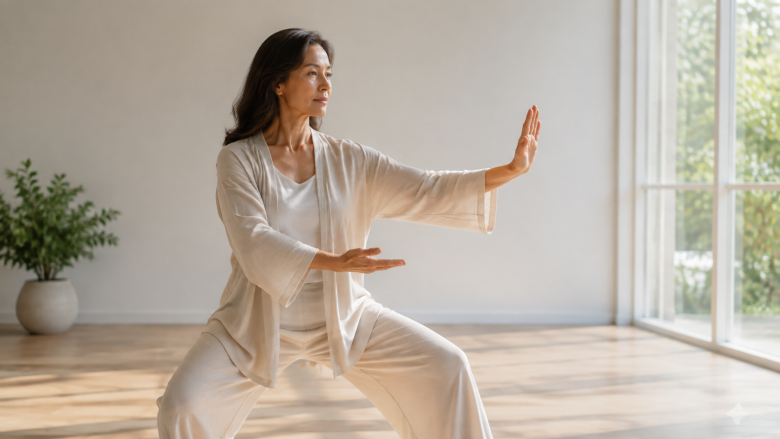
Tai chi for balance is a skill-building practice, not a workout. It targets the three subsystems your brain relies on for stability: your vision, your inner ear (vestibular system), and your proprioception—the sense of where your body is in space. Each tai chi move can be layered to challenge these systems progressively. This is the “gentle movement” approach: low impact, high cognitive demand, measurable results.
Let’s be clear about what tai chi can and cannot do. It won’t give you a cardio workout. It won’t build big muscles. But it will improve your ability to shift weight with precision, react to perturbations, and walk with confidence. In one of the most cited studies, the National Institute on Aging noted that tai chi reduced falls by up to 45% in older adults—a significant number, but it only applies if you practice consistently and progress deliberately.
This guide is not a “3 moves for seniors” listicle. It’s a progressive framework—a 4-week map that takes you from seated stability to Tai Chi Walking, with checkpoints to measure your improvement. If you’re also looking to build a daily movement habit, our 30-Day Gentle Walking Challenge for Beginners pairs well with this practice.
What Balance Actually Requires: The Three Systems
Before you step onto the mat, understand what you’re training. Balance is not a single ability. It’s a conversation between three systems, each of which degrades with age and inactivity:
- Visual system: Your eyes tell your brain where you are relative to the world. This is the dominant system for most people—which is why closing your eyes makes balance dramatically harder.
- Vestibular system: Your inner ear detects head position and acceleration. It’s the system that keeps you oriented when you turn your head or look up.
- Proprioceptive system: Receptors in your joints and muscles sense stretch and tension, telling your brain where each limb is without looking. This is the system that “wakes up” through tai chi practice.
Most balance exercises—standing on one leg, walking heel-to-toe—train only one or two of these systems at a time. Tai chi stands out because every move integrates all three. The slow weight shifts force your proprioceptors to fire constantly. The changing head positions challenge your vestibular system. And the focal point (your gaze) trains your visual system to work with, not override, the other two.
Here’s what most people don’t realize: your brain prioritizes these systems in a fixed order. If vision is available, it uses vision first. If vision is compromised (like in a dim hallway), it relies on vestibular. If that fails, it falls back to proprioception. Tai chi trains the brain to switch between these systems more fluidly, so when one is compromised—like when you’re carrying groceries and can’t see your feet—your other systems step up.
This is why tai chi is superior to simple strength training for balance. Squats build muscle, but they don’t teach your brain to use those muscles in dynamic, unpredictable situations. Tai chi does.
Why “Just Practicing” Is Not Enough: The Progression Gap
The biggest mistake I see in balance training—and the gap in most articles—is the assumption that just doing the same moves daily is sufficient. It’s not. Your brain adapts to a specific challenge within 2 to 3 weeks. If you practice the same “wave hands” move at the same height with the same speed, you’ll plateau quickly.
When I first started teaching tai chi, I made the mistake of keeping my students on the same routine for months. They improved initially, then stalled. Some even regressed because they were bored and lost focus. The fix was to introduce layered challenges—small, incremental demands that forced their systems to keep adapting.
Think of it like strength training. You don’t lift the same 5-pound weight for a year and expect to get stronger. Balance is the same. Without progressive overload, your brain has no reason to build new neural pathways.
Here’s the thing nobody tells you about balance progression: it’s not linear. Some weeks you’ll feel dramatically more stable. Other weeks you’ll feel shakier for no obvious reason. This is normal. Your brain is reorganizing, and temporary instability is often a sign of learning. The key is to know which checkpoints matter and to trust the process.
The 4-Week Tai Chi Balance Progression Map
This progression is designed to move you from a stable, seated practice to dynamic, walking balance. Each week builds on the last, layering new sensory challenges. You’ll need 10-15 minutes a day, a chair for support, and a clear space about 3 feet by 3 feet.
Before you begin, take a baseline. Stand with your feet hip-width apart, arms at your sides. Close your eyes. How long can you hold without swaying or opening your eyes? If it’s less than 10 seconds, focus on Weeks 1-2. If you can hold 30 seconds, you can start with Week 3. This is your starting checkpoint.
Week 1: Seated Stability and Weight Awareness
This week is about building the foundation: feeling your weight, learning to shift it with control, and activating the small stabilizing muscles around your ankles and hips.
Move: Seated Weight Shifting
Sit on a chair with your feet flat on the floor, hip-width apart. Place your hands on your thighs. Slowly shift your weight to your right sit bone, then your left, moving like a pendulum. Your spine stays tall, your shoulders relaxed. Do this for 2 minutes, eyes open.
The key is to move from your pelvis, not your upper body. Most people initiate shifts with their shoulders, which throws off the whole alignment. Imagine a plumb line from the top of your head through your sit bones. Shift that line, not your torso.
Progression checkpoint: By Day 7, you should be able to shift your weight smoothly without your feet lifting off the floor or your upper body leaning. You should feel the pressure change under your feet and your opposite sit bone.
When I teach this to beginners, I see two common errors. First, they hold their breath. Exhale as you shift. Second, they rush. A full shift from right to left should take at least 3 breaths—about 10 seconds. If you’re doing it faster, you’re not actually training your balance; you’re just moving your body.
Week 2: Standing Weight Shifts with Gaze Control
Now we take the same principle to standing, adding the visual system. This is where balance gets real.
Move: Standing Rocking Horse
Stand with your feet hip-width apart, holding a chair back with one hand for support. Shift your weight forward onto the balls of your feet, then back onto your heels, like a slow rocking horse. Keep your knees soft, not locked. Your gaze stays fixed on a point at eye level ahead of you.
Do this for 3 minutes. The forward shift should be small—just enough to feel your toes press down. The backward shift should feel your heels take weight. You’re not moving your feet; you’re moving your center of mass.
This move challenges your ankle strategy—the first line of defense your body uses to correct small perturbations. By practicing it slowly, you’re teaching your brain to make micro-adjustments constantly, which is exactly what you need when you’re on uneven ground or carrying something heavy.
Progression checkpoint: By the end of Week 2, you should be able to do the rocking horse with just a fingertip on the chair for support. You should notice that your ankle muscles are working in a way they don’t during normal walking—small, constant adjustments.
Most people don’t realize how much they rely on their vision to maintain balance. When you fix your gaze, you’re actually making the exercise harder in a specific way: you’re preventing your visual system from “gripping” the environment. This forces your proprioceptive system to work harder.
Week 3: Single-Leg Stance and Turning the Head
Week 3 layers the vestibular system. This is the week where most people feel challenged, and it’s also where the real balance gains happen.
Move: Single-Leg Stance with Head Turns
Stand behind a chair, holding on with both hands. Shift your weight onto your left foot, and lift your right foot an inch off the floor, bending your knee. Keep your standing leg soft, not locked. Once stable, slowly turn your head to the right, then back to center, then to the left. Keep your eyes open and try to fix your gaze on a point as you turn.
Do this for 1 minute per leg. If you feel dizzy or unstable, keep your head still and just hold the single-leg stance. That’s fine. The vestibular system adapts slowly, and pushing too hard can cause falls.
This move teaches your brain to use your inner ear for stability while your vision is in motion. In daily life, this is what happens when you turn to look over your shoulder while walking—a common cause of falls in older adults.
Progression checkpoint: By the end of Week 3, you should be able to hold the single-leg stance for 30 seconds on each side with just one hand on the chair. Your head turns should be smooth, not jerky. If you feel unsteady, go back to the rocking horse and add head turns to that move instead.
Here’s a trade-off to be aware of: this exercise is more demanding, but it’s also where you’re most likely to get hurt. If you have a history of falls or vestibular issues, work with a physical therapist or a qualified tai chi instructor before attempting head turns. The risk of injury from a fall outweighs the benefit of faster progression.
Week 4: Tai Chi Walking
Now we integrate everything. Tai Chi Walking is the foundational gait pattern of tai chi, and it’s the most effective way I know to improve real-world balance.
Move: Tai Chi Walking with Heel-Toe Steps
Stand with your feet together, hands at your sides. Shift your weight fully onto your right foot. Lift your left foot, and place it forward—heel first—as if you’re stepping over a small puddle. Set your heel down, then roll through your foot to the ball, then the toes. As your weight transfers to your left foot, your right foot becomes free. Lift it, step forward past your left foot, and repeat.
This is not normal walking. Each step is slow, intentional, and controlled. Your weight should be fully on one foot before the other foot lifts. Your steps should be about half your normal stride length. Keep your gaze forward, not down at your feet.
Do this for 5 minutes, turning around when you run out of space. Use a wall or a long counter for support if you need it.
Tai Chi Walking trains your reactive stepping mechanism—the step you take to catch yourself when you trip or slip. By practicing slow, deliberate steps backward and forward, you’re teaching your brain to execute a successful step under pressure.
Progression checkpoint: By the end of Week 4, you should be able to walk 10 steps in a straight line without touching a wall or support. Your steps should be smooth, with no hesitation. You should feel your core engaging and your gaze steady.
This is where the practice becomes genuinely life-changing. When you walk around your house, you’ll notice you’re more aware of your weight distribution. You’ll catch yourself before stumbling. That’s not coincidence—that’s your brain using the new pathways you’ve built.
Balance Checkpoints: How to Know You’re Improving
You can’t improve what you don’t measure. Here are three simple checkpoints you can do at home, once a week, to track your progress. Do them at the same time of day, ideally before your practice session, and record the results.
- The Stance Test: Stand with feet together, arms crossed, eyes closed. Time how long you can hold without opening your eyes or moving your feet. A healthy baseline is 30 seconds. Most beginners start at 10-15 seconds.
- The Single-Leg Test: Stand on one leg, hands on hips, eyes open. Time how long you can hold. Aim for 30 seconds per side. This tests your ankle and hip strategies.
- The Functional Reach Test: Stand with your side against a wall, arm extended at shoulder height. Reach forward as far as you can without taking a step. Mark where your fingertips end. This tests dynamic balance and weight-shift accuracy.
These checkpoints are not a contest. They’re data. If your Times improve by 20% over 4 weeks, you’re on track. If they stay flat, you’re either not challenging yourself enough or you’re practicing too inconsistently.
One note: balance is affected by sleep, stress, and medication. Don’t panic if one week you regress. Look at the trend over 4 weeks, not the daily fluctuation.
Yoga vs. Tai Chi for Balance: Which Should You Choose?
This is a common question, and the answer depends on your goals. Both yoga and tai chi improve balance, but they do it differently. Yoga tends to emphasize static holds and flexibility. Tai chi emphasizes dynamic weight shifts and continuous movement.
For balance specifically, tai chi has a distinct advantage: it trains your reactive balance, not just your static balance. In yoga, you hold a pose like tree pose for 30 seconds. That’s static balance—training your body to maintain a position. In tai chi, you’re constantly moving in and out of stances, which is closer to what you do in daily life. You’re never still, so your brain is always adjusting.
That said, yoga’s emphasis on ankle strength and hip mobility is valuable. A combined approach—yoga for flexibility, tai chi for dynamic balance—is what I recommend for most people over 50. But if you can only do one, and your primary goal is fall prevention, tai chi wins. A 2017 review in the Journal of the American Geriatrics Society concluded that tai chi is more effective than yoga for reducing falls in older adults, though both are beneficial.
There’s also a newer question: does yoga or tai chi work better for people with specific conditions like Parkinson’s disease? Both have evidence. Tai chi has a slight edge for gait and balance specifically, while yoga may be better for flexibility and stress. But the best exercise is the one you’ll do consistently. If you find yoga boring and tai chi engaging, that consistency will beat any theoretical advantage.
Does 7 Minutes of Tai Chi Really Work?
You’ve seen the headlines: “7 minutes of tai chi a day cuts falls by 40%.” Is that accurate? Yes and no. The study that popularized this claim, published in the Journal of the American Heart Association, used a simplified 7-minute routine. Participants practiced daily, and the results were impressive—especially for older adults at risk of falls.
But here’s the nuance: that 7-minute routine was specifically designed for people who couldn’t do longer practices. It included key balance moves like weight shifting and single-leg stance. It worked because it was consistent and targeted, not because 7 minutes is magical.
In my experience, 7 minutes is enough to maintain balance if you’re already stable, but it’s not enough to build significant balance if you’re starting from a low base. For most beginners, I recommend 10-15 minutes daily. That’s long enough to move through a full progression sequence without losing focus.
The real lesson is consistency over duration. A 7-minute daily practice beats a 45-minute practice once a week. Your brain needs repeated, spaced exposure to build neural pathways. If 7 minutes is what you can sustain, do it—but make every minute count. Don’t just go through the motions; focus on the quality of your weight shifts and your breath.
Safety First: When to Be Cautious with Tai Chi
Tai chi is gentle, but it’s not risk-free. The slow, deliberate movements can be challenging for people with certain conditions. Here are the situations where I’d advise extra caution or a doctor’s consultation:
- Severe osteoporosis: The twisting movements in tai chi can put stress on the spine. Modified versions exist, but you need professional guidance.
- Vestibular disorders: If you have Meniere’s disease or chronic dizziness, head turns can trigger symptoms. Start with a seated practice and work with a specialist.
- Recent joint replacement: Tai chi is often recommended after hip or knee replacement, but only after your surgeon clears you. The weight shifts can be too much in the first few months.
- Uncontrolled heart conditions: While tai chi is low-intensity, the deep breathing can affect blood pressure. If you have a cardiac condition, get medical clearance first.
If you feel sharp pain during any move, stop. Tai chi should produce a gentle stretch, not pain. And never practice on a slippery floor or in socks. Barefoot or with non-slip shoes is best.
The most dangerous time is the first week. You’re excited, you want to progress, and you might push too hard. Start with the seated exercises, master them, and then stand. This is not about being overly cautious—it’s about building a sustainable practice.
If you’re looking for a structured way to add more movement to your day, consider pairing this practice with our 30-Day Gentle Walking Plan for Beginners. Walking and tai chi complement each other perfectly: walking builds endurance, tai chi builds balance.
Building a Sustainable Practice
The most common question I get is, “How long until I see results?” The honest answer: most people notice a difference in their balance within 2 to 3 weeks. Falls reduction takes longer—usually 8 to 12 weeks of consistent practice. But the improvements are real and measurable.
Here’s my final advice for making tai chi a habit:
- Schedule it: Do it at the same time every day. Morning is best for most people—it sets your balance system for the day.
- Write it down: Keep a simple log of your daily checkpoints. Seeing your single-leg time improve from 12 to 25 seconds is motivating.
- Find a community: A class or an online group keeps you accountable. But even 10 minutes of solo practice is better than skipping.
- Be patient: Balance is a skill, not a pill. It takes time for your brain to build new pathways. Trust the process.
Tai chi for balance is not a quick fix. It’s a re-education of your body’s stability systems. But if you stick with it, you’ll notice something profound: not just better balance, but more confidence in everything you do—walking on uneven ground, reaching for something on a high shelf, or simply feeling steady on your feet. That confidence is the real gift of this practice.
For more on integrating gentle movement into your daily routine, explore our guide on Energizing Morning Routine with Light Movement to see how tai chi fits into a holistic approach to wellness.