Why Gentle Beats Forceful for Ankle Mobility
If you have stiff ankles, you have probably been told to push harder, stretch deeper, and grind through the pain. I have been there too. When I first started working on my own limited dorsiflexion, I made the mistake of forcing my knee over my toe with a heavy band, thinking more tension meant more progress. The result was a sharp twinge in my Achilles that took weeks to settle.
Here is the thing nobody tells you about ankle mobility: your ankle stiffness is often your body’s protective brake, not a structural wall. If you try to yank it open, your nervous system will simply slam that brake harder. A gentle approach works with your nervous system instead of fighting it, inviting the joint to release rather than forcing it to comply.
This guide is different from the typical ankle mobility routine. It is designed for people who need low-impact, pain-aware movement. If you are a beginner, a senior, or someone managing chronic pain or an old injury, these seated and lying exercises will help you build range safely. The goal is not to achieve a perfect 45-degree ankle bend overnight. The goal is to teach your ankles that movement is safe, and to make small, consistent gains over time.
What Ankle Mobility Actually Means (and Why It Matters More Than You Think)
Ankle mobility refers to the range of motion available at the talocrural joint — the joint where your shinbone (tibia) meets the talus bone in your foot. When we talk about improving it, we are usually talking about dorsiflexion (bringing your toes toward your shin) and plantarflexion (pointing your toes away). But true mobility also includes inversion and eversion (tilting the sole inward and outward) and rotation.
Every step you take, every squat you perform, and every staircase you climb depends on your ankle’s ability to move freely. When this joint is restricted, the body compensates. Your knees may cave inward, your hips may rotate excessively, and your lower back may round. Over time, those compensations can lead to the knee, hip, and back pain that many people blame on aging or bad luck.
But here is what most guides miss: the ankle is packed with sensory receptors that feed information to your brain about balance and position. A stiff, guarded ankle is often a sign of a nervous system that feels unsafe. This is why gentle, slow movement is not just a nice alternative — it is often the most effective approach for people who have been struggling with chronic tightness.
Understanding the Nervous System’s Role in Ankle Stiffness
When you experience pain or injury, your brain learns to protect that area. It does this by increasing muscle tension and reducing range of motion. This is a normal, protective response. The problem is that for many people, that protection never turns off, even after the tissue has healed.
Gentle mobility work sends a new signal to the brain: It is safe to move here. By moving slowly, breathing deeply, and staying within a pain-free range, you gradually teach your nervous system to relax its guard. This is why breathwork and patience are not just fluffy additions — they are essential components of the practice.
Before You Start: The 5 Ground Rules for Gentle Ankle Work
These are the principles I use with every client or friend who comes to me with stiff ankles. They apply whether you are doing a full routine or just two minutes of movement before bed.
- Rule 1: No pain, no gain is a lie. You should feel a gentle stretch or a sense of pressure, never a sharp or pulling pain. If something hurts, back off the range by 20 percent.
- Rule 2: Breathe like you mean it. Exhale as you move into the stretch, inhale as you release. This signals relaxation to your nervous system.
- Rule 3: Small is valid. A 5-degree improvement in a month is a victory. Forget Instagram-worthy full squats.
- Rule 4: Consistency beats intensity. Ten minutes daily is infinitely better than 40 minutes once a week.
- Rule 5: Warm tissue moves better. If your ankles are cold, spend a few minutes warming them with gentle friction or a warm foot soak before you begin.
Think of this work as a conversation with your ankle, not a command. You are asking, “Can we move a little more today?” not demanding, “Move or else.”
The Gentle Movement Framework: A 3-Phase Approach
Most ankle mobility articles give you a list of exercises. This one gives you a framework. The three phases are: Engage, Mobilize, and Integrate. Each phase has a specific purpose, and together they create a complete practice that is both safe and effective.
Phase 1: Engage (Waking Up the Joint)
Before you stretch anything, you need to wake up the ankle. This phase is about circulation and sensory awareness. It is especially important for those with chronic pain, because it helps reduce the “guarding” response we talked about earlier.
Gentle Ankle Pumps (100 reps)
Sit on a chair or lie on your back with your legs extended. Gently point your toes away from you (plantarflexion), then flex them back toward your shin (dorsiflexion). Do this slowly, with control, as if you are pressing a pedal underwater. Aim for 50 to 100 repetitions. This pumps out lymphatic fluid and wakes up the calf muscles.
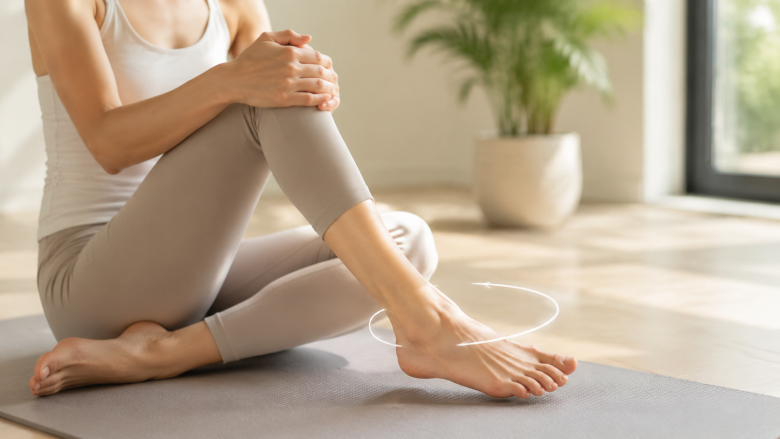
Ankle Circles with a Twist
Instead of large, fast circles, make small, slow circles in one direction. Focus on the sensation of the circle being as round as possible. Do 10 circles one way, then 10 the other. The key is to move from the ankle, not the hip.
Toe Spreads and Lifts
This sounds too simple to matter, but it does. Sit with your feet flat on the floor. Try to spread your toes apart and lift them one by one. This improves the connection between your foot and your brain, which has a direct effect on ankle control.
Phase 2: Mobilize (Inviting Range of Motion)
Now that the joint is warm, you can start to explore range. This phase is where you will spend most of your time. Remember: no pain.
Seated Dorsiflexion Stretch
Sit on a chair with your feet flat on the floor. Slowly slide your knee forward over your second toe, keeping your heel down. Go only until you feel a gentle stretch in the back of your ankle. Hold for a breath, then slide back. Repeat 10-15 times.
Most people don’t realize this, but the key is not how far you slide. The key is keeping your heel grounded. If your heel lifts, you are cheating and you are not actually working on dorsiflexion.
Lying Calf Stretch with a Towel
Lie on your back with your legs extended. Loop a towel around the ball of your foot and gently pull your toes toward your shin. You should feel a stretch in your calf and Achilles. Hold for 30 seconds, breathing deeply, then release. Repeat 3 times on each leg.
Seated Inversion and Eversion
Sit with your ankle resting on the opposite knee. Gently tilt your foot so the sole faces inward (inversion), then outward (eversion). Move slowly, exploring the edges of your range. This is often neglected but is crucial for balance and preventing lateral ankle sprains.
Phase 3: Integrate (Using the New Range)
This phase is about teaching your body to use the new mobility in functional patterns. It is gentle, but it is here that the magic happens.
Assisted Squat (or Sit-to-Stand)
Stand in front of a sturdy chair. Hold onto a countertop or a doorframe for support. Slowly sit back into the chair, keeping your heels down as much as possible. Then, using your hands for balance, stand back up. Focus on how your ankle moves as you shift your weight. Do 5-8 slow reps.
Heel Raises (Bodyweight Only)
Stand with your hands on a wall or counter. Slowly rise onto your toes, then lower back down with control. Do not bounce. This strengthens the calf and improves plantarflexion range. Start with 10 reps, and work up to 20.
Walking Practice
This is the ultimate integration. Take 2 minutes to walk slowly, focusing on your heel-to-toe roll. Can you feel your ankle moving? If not, that is fine. Just the awareness is the first step. If you are ready to build a daily walking habit, our 30-day gentle walking plan for beginners is a perfect companion to this ankle work.
10 Gentle Ankle Mobility Exercises to Do at Home
Here is a complete, sequenced routine. You can do the whole thing in about 15 minutes. Do it daily, or at least every other day. This is the exact sequence I recommend to friends and family who are new to mobility work.
1. Warm-Up Ankle Pumps (2 minutes)
Sit or lie down. Pump your toes up and down 50 times. The goal is to get blood moving, not to stretch.
2. Slow Ankle Circles (1 minute)
Lift one foot slightly off the floor. Draw small, slow circles with your toes. 10 circles each direction. Keep your knee still.
3. Towel Stretch (2 minutes)
Use a towel to pull your toes toward your shin. Hold for 30 seconds, rest 10 seconds, repeat 3 times per leg.
4. Seated Knee Slides (2 minutes)
In a seated position, slide your knee forward over your toes while keeping your heel down. Go only to a mild stretch. 15 slow reps per leg.
5. Toe Taps (1 minute)
Sit with feet flat. Tap your toes on the floor without lifting the ball of your foot. This is a small movement, but it works on the ankle’s ability to flex and extend.
6. Calf Raises on a Step (or Flat Floor)
If you have a step, hold the railing and let your heels hang down for a gentle stretch. Then rise onto your toes. If that is too much, do them on flat ground. 10-15 reps.
7. Inversion/Eversion Tilts (1 minute)
Sit with your ankle crossed over your knee. Gently tilt your foot inward and outward. 10 reps each side.
8. The Alphabet (1 minute)
Lie down and lift your leg. Trace the alphabet in the air with your toes. This is a classic physical therapy exercise, and for good reason — it moves the ankle through all its ranges gently.
9. Standing Ankle Stretch (2 minutes)
Stand facing a wall, hands on the wall. Place one foot back, keeping the heel down. Slowly bend the front knee until you feel a stretch in the back calf. Hold 20 seconds, repeat 3 times per leg.
10. Breath and Release (2 minutes)
Lie on your back with your legs extended. Close your eyes. Breathe deeply for 10 breaths, and on each exhale, consciously relax your feet and ankles. This is the nervous-system reset that makes all the other work stick.
How to Turn This Into a Calming, Restorative Practice
Gentle ankle mobility can be more than just physical therapy. It can become a form of self-care that helps you wind down, especially at the end of the day. This is where the “Gentle Movement” angle becomes truly powerful.
When I was recovering from a foot injury, I would do my ankle routine on the floor of my living room at 9 PM, with the lights dimmed and a podcast playing softly. It became the most peaceful part of my day. The slow, rhythmic movements and the focus on breath were almost meditative.
Here is how to make that happen for you:
- Set the scene. Sit on a yoga mat or a thick rug. Light a candle or dim the lights. Put on slow, instrumental music.
- Pair with your breath. Inhale for 4 counts as you prepare, exhale for 6 counts as you move. This extended exhale is a proven way to activate your parasympathetic nervous system.
- Do it before bed, not after a workout. If you do it after a hard workout, you will be in a sympathetic (fight-or-flight) state, and the gentle movements will feel less effective. Doing it before bed helps your body transition into rest mode.
- Use it as a transition. If you have a hard time falling asleep, a 10-minute ankle mobility practice can be part of your bedtime routine. The combination of gentle movement and breathwork is a natural sleep aid.
For a structured way to start your day with similar gentle principles, check out our energizing morning routine with light movement. It pairs beautifully with this ankle practice.
Common Mistakes That Sabotage Your Progress (And What to Do Instead)
I have seen people do ankle mobility exercises for months without results. The problem is rarely the exercise selection. It is almost always one of these four mistakes.
Mistake 1: Pushing Through Pain
This is the most common and the most damaging. If you feel a sharp pain, your body is telling you to stop. Pushing through it only reinforces the protective response. The result is more stiffness, not less.
What to do instead: Back off the range by half. If it still hurts, stop that exercise for the day. Try again tomorrow with a smaller movement.
Mistake 2: Bouncing or Jerky Movements
Ballistic stretching (bouncing) can cause micro-tears in the tissue and make the nervous system more guarded. It is the opposite of what we want.
What to do instead: Move slowly and with control. Think of it as “sneaking” into a deeper range. The slower you go, the more your brain trusts the movement.
Mistake 3: Holding Your Breath
When people focus on a stretch, they often hold their breath. This increases tension and prevents relaxation.
What to do instead: Exhale as you move into the stretch. Inhale as you release. If you forget, just return to normal breathing — the key is to breathe continuously.
Mistake 4: Inconsistency
Doing a 30-minute session once a week is not as effective as a 10-minute session every day. Joint mobility is like a conversation — it needs regular check-ins, not a yearly summit.
What to do instead: Commit to 5 minutes a day. Even if it is just ankle pumps while you brush your teeth, that counts. Consistency is your superpower.
When to Be Careful: Contraindications and Red Flags
Gentle movement is generally safe for everyone, but there are times when you should be extra cautious or seek professional advice.
- Acute injury: If you have recently sprained your ankle or have a suspected fracture, do not do these exercises. Wait until you have been cleared by a doctor or physical therapist.
- Severe osteoporosis: If you have been diagnosed with osteoporosis, some positions may be risky. Work with a professional to choose safe variations.
- Numbness or tingling: If you feel numbness, tingling, or a “pins and needles” sensation in your foot during these exercises, stop and consult a healthcare provider.
- Post-surgery: If you have had ankle surgery, your surgeon’s restrictions take priority. Never do any exercise that is not specifically approved by your surgical team.
If you are in doubt, a great rule of thumb is to try the exercise in a very small range and see how your body responds. If it feels good, you can gradually increase. If it feels wrong, stop.
How Long Until You See Results? A Realistic Timeline
I want to be honest with you, because most articles are not. The timeline for ankle mobility improvements varies wildly depending on the cause of your stiffness.
If your stiffness is mostly muscular and you are relatively active, you might notice a difference in 2-3 weeks of daily practice. If you are dealing with chronic pain, arthritis, or a long-ago injury, it could take 2-3 months of consistent work to see meaningful change. That is not a failure — that is your body’s protective system slowly learning to trust again.
The most important measure of progress is not how far you can slide your knee. It is how your ankles feel during daily activities. Do stairs feel easier? Can you walk a little longer without discomfort? These are the wins that matter.
If you are also trying to walk more as part of your recovery, a great way to integrate your new ankle mobility is with a structured walking program. Our 30-day gentle walking challenge for beginners can help you build stamina without overwhelming your joints.
Putting It All Together: Your Simple Daily Routine
Here is a simple checklist you can use every day. It takes about 10 minutes.
- Warm-up: 50 ankle pumps (1 minute)
- Circles: 10 each direction per ankle (1 minute)
- Towel stretch: 3 sets of 30 seconds per leg (3 minutes)
- Seated knee slides: 15 reps per leg (2 minutes)
- Heel raises: 10-15 reps (1 minute)
- Breath and release: 10 deep breaths (2 minutes)
Print this or save it on your phone. Do it while watching TV, listening to a podcast, or before bed. The key is to do it, not to do it perfectly.
And remember: this is not about fixing a broken ankle. It is about honoring the body you have and giving it the gentle attention it deserves. The fact that you are here, looking for a kinder way to move, tells me you are on the right path.
Start with one exercise today. Just one. See how it feels. Then come back tomorrow and do another. That is all it takes.